When the smoke detector wakes up, the BESS container battery pack or cell hass already gone
What an LFP thermal-runaway test taught us about the hydrogen window before failure
Detection failure before smoke signals occur
By the time a fire alarm starts beeping in a battery room, the fight is over. The cell has vented, the temperature has crossed 200°C, the casing has ruptured, and you are no longer protecting an asset — you are managing a disaster.
We ran the test below to put a number on that statement.
The setup
A single lithium iron phosphate (LFP) cell, instrumented with three independent measurements:
- Output voltage — the battery management system’s view of the world.
- Surface temperature — what a contact thermistor or fire-safety thermal probe would see.
- Fast Sense H₂ sensor response — a chip-scale hydrogen sensor placed next to the cell.
We pushed the cell into thermal runaway and let the three signals tell their story.
What happened
For the first 60 minutes, nothing.
Voltage held flat at 3.2 V. Temperature crept from 21°C to 25°C — within ambient room-to-room variation. Any monitoring system watching either of those signals would have logged a quiet, healthy battery.
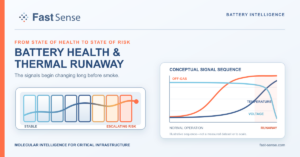
The hydrogen sensor told a different story. Starting around minute 20, it began registering a slow climb above its baseline. By minute 44 the H₂ signal had doubled. By minute 60 it had climbed an order of magnitude. By minute 80 — fifteen minutes before runaway — the sensor was reading more than 100 times baseline.
Then the cell let go.
At minute 96 the surface temperature jumped from 86°C to 200°C in under thirty seconds. The voltage briefly spiked to 190 V as internal short-circuits ripped through the cell, then collapsed to zero. If this had been a real installation, that thirty-second window is when the fire alarm would have triggered.
By then the H₂ sensor had been screaming for over an hour.
Why hydrogen leads thermal runaway
The chemistry is well understood. Long before a lithium cell goes thermal, the SEI layer breaks down, electrolyte solvents start decomposing, and the cell begins outgassing — primarily hydrogen, with smaller fractions of CO, CO₂, methane, ethane and ethylene. The hydrogen fraction is the highest-mobility molecule in the mix. It is also the lightest, the most reactive, and the one that escapes the cell casing first.
Every other detection modality is downstream of this:
- Smoke detection waits for solid combustion products. By the time those exist, the cell is already burning.
- Heat detection waits for surface temperature to cross a threshold — typically 60–80°C for early warning, 90°C+ for confirmed alarm. In our test, temperature stayed below 50°C for the first 70 minutes while H₂ was already at 70× baseline.
- Voltage / cell impedance monitoring detects the failure event itself, not the precursor. By the time voltage signatures change meaningfully, you are no longer in a prevention conversation.
Hydrogen is the only signal that gives you a usable warning window before the failure becomes irreversible.
What 75 minutes is actually worth
Pre-runaway warning is not a theoretical capability. It is the difference between three operational outcomes:
At zero warning (the smoke-and-heat status quo) you are doing damage control. Suppress, isolate, evacuate, and hope the fire-rated walls hold.
At 5–10 minutes you can isolate the affected rack, dump the affected string, and route load. You still lose the cell.
At 60+ minutes you can identify the failing cell, take it offline gracefully, and replace it during scheduled maintenance. The asset is preserved, the surrounding cells are protected, and the operator never enters an emergency response posture.
That is the gap our chip-scale H₂ sensor closes.
What this means for fire-safety OEMs
If you build smoke detectors, aspirating smoke detection, or BESS-room safety systems, hydrogen detection is not a competing product line — it is a missing layer of your existing one. Fire detection is already organised around staged escalation: pre-alarm, alarm, evacuation. What is missing is a stage zero — a pre-thermal-event signal that lets the system flag a failing cell while the room is still cold and quiet.
A chip-scale sensor changes the calculus on whether that stage zero is economically deployable. Discrete electrochemical or pellistor H₂ sensors at $400–$1,200 per node are not going into every rack. A $30 chip-scale module with five-year stability is.
What this means for BESS operators and integrators
Most container BESS designs today rely on a smoke detector or aspirating smoke head as the primary in-cabinet sensor, with thermal probes on the strings. Both are post-event. If you are already deploying thermal probes per string, adding chip-scale H₂ at the same cadence costs less than the thermal probe and gives you the warning window the thermal probe cannot.
For new builds, the integration argument is straightforward. For existing fleets, the retrofit case is even better — chip-scale sensors are small enough to live inside the cabinet without re-engineering the airflow.
The point
The chart from this test is the most boring one we have shown publicly. Three lines on a graph. The boring part is the point: for over an hour, the battery looked fine on every signal a conventional safety system can see. The hydrogen line had been telling the truth the whole time.
If you build, specify, or operate battery storage and fire-safety systems and you want to look at the raw data, message me. We are running a small number of OEM and pilot conversations right now and would rather hand you the dataset than the marketing version.
— David Suter, Founder, Fast Sense
Latest Posts

Battery Fire Safety Getting Crititcal
August 23, 2026