H2 Off Gassing detection-in-batteries
Lithium-Ion Battery Off Gassing: Why Early Gas Detection Matters
Lithium-ion batteries power phones, laptops, tools, vehicles and battery energy storage systems (BESS). They are generally safe when well designed, correctly charged and used as intended. When a cell is defective, damaged, overheated or electrically abused, however, the same high energy density that makes it useful can make a failure develop quickly.
Hydrogen Off Gassing deserves particular attention because it is colorless, odorless, highly diffusive and flammable at about 4.1% by volume in air under commonly referenced test conditions. Yet battery gas safety is more complex than watching hydrogen alone. A failing lithium-ion cell may release Off Gassing compounds such as hydrogen, carbon monoxide, carbon dioxide, hydrocarbons and electrolyte vapors; a fire can also produce toxic hydrogen fluoride.
There is another important distinction. Vented lead-acid batteries can generate hydrogen during normal charging, especially near full charge. A lithium-ion cell should not routinely vent during normal operation. For lithium-ion systems, unexpected gas is more likely to be a warning of abnormal degradation or failure. In both cases, the safety goal is the same: detect a developing hazard early enough to act before heat, gas and pressure escalate.
Key point: Gas detection does not replace a battery management system, smoke and heat detection, ventilation, fire protection or emergency planning. It adds another layer of information—often at an earlier stage of failure.
Why do lithium-ion batteries explode?
Lithium-ion batteries can explode when an internal failure releases heat and flammable vent gases faster than the system can dissipate them. If gas accumulates in a confined space and finds an ignition source, pressure can rise rapidly. Overcharge, internal short circuits, physical damage, manufacturing defects and external heating can initiate this sequence.
A lithium-ion cell stores electrical energy in closely packed electrodes separated by a thin porous membrane and a flammable organic electrolyte. Three broad types of abuse can destabilize that structure:
- Electrical abuse: overcharging, over-discharging or an external short circuit.
- Mechanical abuse: crushing, puncture, vibration or impact.
- Thermal abuse: external fire, inadequate cooling or exposure to excessive heat.
These triggers can damage the separator and create an internal short circuit. Heat then accelerates reactions among the anode, cathode and electrolyte. A battery explosion is not inevitable: a cell may simply swell, vent, smoke or burn. The outcome depends on chemistry, state of charge, cell design, surroundings and whether vent gases ignite. Reviews in the Journal of Energy Chemistry and Energy Storage Materials describe these linked mechanical, electrical and thermal failure pathways in detail (Chen et al., 2021; Feng et al., 2018).
What is thermal runaway?
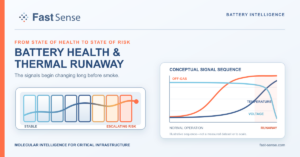
Thermal runaway is a self-accelerating failure in which heat-producing reactions inside a battery generate more heat than the cell can release. Rising temperature speeds further reactions, creating a feedback loop. The cell may vent hot, flammable and toxic gases, ignite, rupture or heat neighboring cells until they also fail.
The phrase is sometimes mistakenly written as “thermal runway,” but thermal runaway is the correct scientific term. It is better understood as a progression than as a single instant:
- A defect or abusive condition begins local heating or unwanted chemical reactions.
- Decomposition inside the cell produces more heat and gas.
- Internal pressure rises; a safety vent may open or a pouch seal may fail.
- Heat generation becomes self-sustaining and difficult to stop.
- Hot gases may ignite, and heat can propagate to adjacent cells.
Once the self-heating reactions are established, disconnecting the charger may no longer stop the event. Prevention and early warning are therefore more reliable strategies than waiting for visible flames.
What causes a swollen phone battery?
A swollen phone battery contains gas produced by unwanted chemical reactions inside its sealed pouch. Aging, prolonged heat, overcharge, deep discharge, manufacturing defects or physical damage can contribute. Swelling means the cell is damaged; it is not a normal cosmetic issue and the phone should not be charged or pressed back together.
A swollen phone battery may lift the screen, separate the case, make the phone rock on a flat surface or create a new gap around the frame. Hissing, popping, unusual heat, leakage or a solvent-like odor are more urgent warning signs. Do not deliberately smell a suspect device.
If a battery appears swollen:
- Stop using and charging the device.
- Power it off if this can be done without pressing, bending or heating it.
- Keep it away from people, exits and combustible materials.
- Do not puncture, squeeze, flatten or attempt to “release” the gas.
- Do not remove a glued-in battery unless you are trained and equipped to do so.
- Ask the manufacturer, an authorized repair provider or a local hazardous-waste program how to handle it.
- If it is smoking, rapidly heating or hissing, move away, warn others and call local emergency services.
The U.S. Environmental Protection Agency describes swelling as battery damage and a potential fire hazard. It also warns that lithium-ion batteries do not belong in household trash or curbside recycling, where they can be crushed and ignite (EPA guidance).
Can the wrong lithium battery charger cause a fire?
Yes. An incompatible lithium battery charger can apply the wrong voltage, current, charge profile or communications protocol. That can overheat or overcharge cells and defeat expected protection. Use the charger supplied or specifically approved by the device manufacturer, and never charge a damaged, swollen, unusually hot or recalled battery.
“Fits the connector” does not mean “safe for the battery.” This is particularly important for e-bikes, e-scooters, power tools and replaceable battery packs. The U.S. Consumer Product Safety Commission has warned that chargers marketed as “universal” can be incompatible with micromobility batteries and can cause them to ignite (CPSC safety warning).
Safer charging habits include:
- Follow the battery and device manufacturer’s instructions.
- Use approved, undamaged charging equipment with the correct electrical rating.
- Charge at room temperature in a dry, visible area.
- Place the product on a stable, hard surface away from beds, sofas, paper and escape routes.
- Do not cover the device or charger; heat needs a path to escape.
- Stop if the battery becomes unusually hot, changes shape, leaks, smells abnormal or makes noise.
- Do not charge batteries that have been dropped, flooded, punctured or recalled until the manufacturer has assessed them.
What does a battery management system do?
A battery management system, or BMS, monitors and controls a battery pack. It can estimate charge and health, balance cells, limit current and disconnect charging or discharge when voltage or temperature leaves permitted ranges. A BMS reduces risk, but it cannot detect or stop every rapidly developing internal cell failure.
The BMS is a central layer of lithium-ion battery safety, especially in multi-cell packs. It may collect voltage, current and selected surface-temperature measurements, manage contactors, control cooling and record faults. It also helps prevent routine operating problems such as overcharge, over-discharge and cell imbalance.
Its limitation is visibility. Surface sensors and pack-level voltage can miss a fast, localized event developing inside one cell. A peer-reviewed thermal-safety review notes that even capable BMS designs may not prevent thermal runaway or propagation when their measurements do not capture rapidly emerging internal changes (Srinivasan et al., 2020). This is why larger systems increasingly use layered monitoring that can include gas, smoke, pressure and heat-rate signals alongside BMS data.
What gases can a failing battery release?
A failing lithium-ion battery can release hydrogen, carbon monoxide, carbon dioxide, methane, ethylene and other hydrocarbons or volatile electrolyte compounds. The mixture changes with cell chemistry, state of charge and failure mode. During fire, fluorinated electrolyte salts can also produce toxic hydrogen fluoride, so “off-gas” should never be treated as hydrogen alone.
Different gases indicate different hazards:
| Gas or vapor | Why it matters |
|---|---|
| Hydrogen (H₂) | Highly diffusive and flammable; useful as an early warning signal in some overcharge and energy-storage scenarios. |
| Carbon monoxide (CO) | Toxic and combustible; can appear during electrolyte and electrode decomposition. |
| Carbon dioxide (CO₂) | Often a major vent-gas component and a useful fault indicator, though normal occupied spaces can have changing background levels. |
| Hydrocarbons and VOCs | May be flammable and can include electrolyte-solvent vapors associated with cell leakage or decomposition. |
| Hydrogen fluoride (HF) | Highly toxic and corrosive; it is not flammable, but it can be produced when fluorinated battery materials decompose. |
Hydrogen’s commonly cited lower flammability limit is about 4.1% by volume in air, but waiting for that level is not an early-warning strategy. Alarm settings must be engineered for the application, relevant regulations, sensor performance, airflow and the actions that the alarm will trigger. The U.S. Department of Energy lists a hydrogen flammability range of approximately 4.1% to 74% in air (DOE safety data).
Toxicity matters as much as ignition. Laboratory fire tests have measured significant hydrogen fluoride emissions from commercial lithium-ion batteries, with results varying by battery type and test condition (Larsson et al., 2017). People should not enter a gas- or smoke-filled battery area without the training, monitoring and protective equipment required by the site’s emergency plan.
What is battery venting?
Battery venting is the release of pressurized gas or vapor from a cell. Cylindrical and prismatic cells may use designed safety vents; pouch cells can swell before a seal opens. Venting can reduce internal pressure, but the discharged plume may be hot, flammable and toxic and can ignite immediately or later.
Off-gassing and venting are related but not identical. Off-gassing describes gas generation or release caused by chemical reactions. Venting describes the physical release from the cell or enclosure. Gas may accumulate inside a pouch before any external release, while a hard-can cell may vent suddenly through a designed weak point.
Venting is a serious warning, not proof that fire will follow. It may provide a short intervention window, but the duration is system- and failure-specific. Treat any unexpected venting, hissing, popping, vapor cloud or sharp solvent odor as a reason to isolate the area and follow the emergency plan.
How does off-gas detection improve battery safety?
Off-gas detection can identify abnormal molecules released before smoke, flame or a large external temperature rise becomes visible. That earlier signal can create time to alarm personnel, stop charging, isolate equipment, change ventilation or begin an engineered response. Lead time varies, so gas sensing should complement—not replace—other safety layers.
Research supports the principle while also showing why careful engineering matters. A 2024 review found that gas sensors can provide earlier warning than conventional temperature and electrical signals in some failure scenarios, with CO₂, carbon monoxide, hydrocarbons and volatile organic compounds among the useful indicators (Wang et al., 2024).
In one overcharge study of a lithium-ion energy-storage cabin, a top-mounted hydrogen detector warned 145 seconds before thermal runaway. Detector location materially changed the detection time (Shi et al., 2023). That result is evidence of potential—not a universal guarantee. Chemistry, enclosure volume, airflow, cell location, sensor selectivity, humidity and alarm logic all affect performance.
A useful off-gas detection design should:
- Start with the battery chemistry, credible failure modes and gas data from representative testing.
- Select the target gas or multi-gas pattern rather than assuming hydrogen is always the first or best marker.
- Model airflow and place sensors where a release can reach them quickly.
- Account for background gases, humidity, poisoning, drift and cross-sensitivity.
- Define alarm thresholds and escalation levels around specific, pre-authorized actions.
- Supervise sensor health, power and communications, and test the complete alarm chain.
- Integrate gas data with the BMS, temperature, smoke, pressure and fire-protection systems.
Early detection creates value only when an alert reaches the right person or control system and initiates a safe, rehearsed response.
How are lithium-ion battery fires suppressed?
Lithium-ion battery fire suppression focuses on protecting people, cooling cells, limiting propagation and controlling secondary fires. Water can be effective for cooling and protecting adjacent cells, but flames may persist or reappear because reactions continue inside damaged cells. The correct system depends on battery scale, electrical hazards, enclosure design and tested performance.
For consumers, a smoking or burning phone, power bank, tool battery or micromobility pack is an emergency: move away, warn others, close a door behind you if safe, and call local emergency services. Do not pick up a hot or venting device or rely on an improvised remedy.
For a commercial or utility installation, battery fire suppression is an engineered system rather than a single extinguisher choice. It can include automatic detection, electrical isolation, separation, containment, sprinklers or other cooling, exhaust or explosion control, and a fire-service response plan. Ventilation changes must be coordinated carefully because introducing air or moving a flammable gas cloud can alter the hazard.
UL Solutions notes that portable extinguishers may not fully extinguish a lithium-ion cell once thermal runaway begins; water may cool adjacent batteries and slow cascading involvement even when it does not immediately stop the failing cell (UL safety guidance). Suppression and ventilation choices should be supported by system-level fire and explosion test data, not generic claims about one agent.
What does NFPA 855 require for battery energy storage?
NFPA 855 is the U.S. installation standard for stationary energy storage systems, not a rule for ordinary phone charging. Its provisions address system planning, commissioning, operation, hazard mitigation and fire or explosion protection. The applicable requirements depend on technology, capacity, location, adopted edition and decisions by the authority having jurisdiction.
The current 2026 edition includes requirements and guidance for electrochemical ESS installations, stored lithium-ion batteries, residential systems and fire testing. It references UL 9540A as a method for evaluating thermal runaway fire propagation. Its annexes also cover BESS hazards, firefighting considerations and suppression and safety guidance (NFPA 855, 2026 edition; UL’s code overview).
NFPA 855 should be read with the locally adopted fire, building and electrical codes, product listings, the manufacturer’s instructions and the project’s hazard mitigation analysis. A gas detector does not by itself make an installation compliant. Depending on the design and adopted rules, off-gas detection may supplement required detection, but the authority having jurisdiction must approve the complete strategy.
A practical layered safety model
The strongest lithium-ion battery safety strategy does not depend on one component:
- Prevent: Use suitable cells, certified equipment, the correct lithium battery charger, thermal management, separation and quality controls.
- Monitor: Combine BMS data with appropriate temperature, smoke, gas, pressure or other condition monitoring.
- Detect early: Identify abnormal off-gassing before conditions reach a flammable or toxic threshold.
- Act automatically: Alarm, stop charging, isolate energy and initiate only the ventilation or protection sequence validated for the system.
- Limit consequences: Use tested spacing, barriers, cooling, suppression and explosion control.
- Prepare people: Maintain emergency procedures, training, remote notification and coordination with the fire service.
This is the central lesson of early molecular detection: the alarm is valuable because of the time it creates and the actions connected to it.
How Fast Sense supports earlier hazard awareness
Fast Sense develops molecular sensing technology for the continuous detection of critical gases such as hydrogen. In battery rooms, energy storage systems, hydrogen infrastructure and industrial energy facilities, real-time gas data can add an earlier layer of visibility to existing safety controls.
Every battery installation is different. Sensor selection, placement, thresholds and response logic should therefore be based on the battery chemistry, enclosure, ventilation, representative test data, applicable codes and a qualified risk assessment. Fast Sense technology should be integrated as part of that larger safety architecture—not treated as a substitute for a BMS, approved fire protection or emergency planning.
Early detection does not remove the hazard. It can create time to prevent escalation.
Frequently asked questions
Is a swollen battery guaranteed to explode?
No. Many swollen batteries never ignite, but swelling proves that the cell is damaged and gas has accumulated. The safe response is to stop using and charging it, avoid pressure or puncture, and obtain professional disposal or repair guidance.
Is hydrogen the only gas worth detecting in a battery room?
No. Hydrogen is central to vented lead-acid charging safety and can be a useful early marker in some lithium-ion failures. Lithium-ion vent gas can also include CO, CO₂, hydrocarbons and electrolyte vapors. Target gases should be selected from chemistry-specific testing and the site risk assessment.
Can a BMS detect a battery fire before it starts?
A BMS can detect many abnormal voltage, current and temperature conditions and may disconnect the pack. It may not see a rapid internal short or early chemical change inside an individual cell, particularly before the effect reaches an external sensor. Multi-signal monitoring improves coverage.
Does off-gas detection replace smoke detection?
No. Gas and smoke sensors detect different stages or products of failure. Off-gas detection may provide earlier warning in a suitable design, while smoke, heat, pressure and flame detection provide other essential information. Code requirements and the authority having jurisdiction determine what is required.
What should an early warning alarm do?
It should trigger a predefined response appropriate to the risk: notify trained personnel, stop charging, isolate affected equipment and initiate an engineered ventilation or protection sequence where approved. An alarm without clear ownership, reliable communication and rehearsed actions provides limited protection.
Scientific and standards references
- Chen Y, Kang Y, Zhao Y, et al. “A review of lithium-ion battery safety concerns: The issues, strategies, and testing standards.” Journal of Energy Chemistry. 2021;59:83–99. doi:10.1016/j.jechem.2020.10.017
- Feng X, Ouyang M, Liu X, Lu L, Xia Y, He X. “Thermal runaway mechanism of lithium ion battery for electric vehicles: A review.” Energy Storage Materials. 2018;10:246–267. doi:10.1016/j.ensm.2017.05.013
- Larsson F, Andersson P, Blomqvist P, Mellander B-E. “Toxic fluoride gas emissions from lithium-ion battery fires.” Scientific Reports. 2017;7:10018. doi:10.1038/s41598-017-09784-z
- Srinivasan R, Demirev P, Carkhuff B, Santhanagopalan S, Jeevarajan J, Barrera T. “Review—Thermal Safety Management in Li-Ion Batteries: Current Issues and Perspectives.” Journal of The Electrochemical Society. 2020;167:140516. doi:10.1149/1945-7111/abc0a5
- Wang X-X, Li Q-T, Zhou X-Y, Hu Y-M, Guo X. “Monitoring thermal runaway of lithium-ion batteries by means of gas sensors.” Sensors and Actuators B: Chemical. 2024;411:135703. doi:10.1016/j.snb.2024.135703
- Shi S, Lyu N, Jiang X, Song Y, Lu H, Jin Y. “Hydrogen gas diffusion behavior and detector installation optimization of lithium ion battery energy-storage cabin.” Journal of Energy Storage. 2023;67:107510. doi:10.1016/j.est.2023.107510
- U.S. Occupational Safety and Health Administration. “Lithium-ion Battery Safety.” 2025. OSHA fact sheet
- National Fire Protection Association. NFPA 855: Standard for the Installation of Stationary Energy Storage Systems. 2026 edition. [Official NFPA preview
Latest Posts
Navigating BESS Insurance: How to Handle Risk Assessments When Thermal Runaway Cover Shrinks
September 24, 2026