
What Is Thermal Runaway and How Does It Affect Battery State of Health?
Thermal runaway is often treated as a sudden, isolated battery failure. In reality, it is usually the final stage of a process that develops as electrical, mechanical or thermal stress overwhelms a cell’s ability to remain stable.
For battery energy storage system operators, the important question is not only what causes thermal runaway? It is also what is happening to battery state of health before the event—and what signals can reveal that change early enough to act?
What is battery state of health?
Battery state of health, or SOH, describes how a battery compares with its condition when new. It is not the same as state of charge.
- State of charge (SOC) tells you how full the battery is now.
- State of health (SOH) estimates how much useful capacity and power capability remain as the battery ages.
SOH is commonly estimated from capacity loss, rising internal resistance, power capability, cycle history, temperature exposure and changes in cell behaviour. A battery at 100% SOC can still have poor SOH.
That distinction matters because an ageing battery may generate more heat under the same load, show greater cell-to-cell variation and have less tolerance for abnormal operating conditions.
What is thermal runaway?
Thermal runaway is a self-accelerating failure in which a cell releases heat faster than the battery and its cooling system can remove it.
The cycle is simple:
- A fault or abuse condition creates heat.
- Higher temperature accelerates unwanted chemical reactions.
- Those reactions release more heat and gas.
- The additional heat drives still faster reactions.
- The process becomes uncontrollable.
Possible triggers include an internal short circuit, overcharge, external heating, mechanical damage, manufacturing defects, lithium plating or a cooling-system failure. If the energy released by one cell heats its neighbours, the event can propagate through a module or rack.
Heat can damage state of health long before runaway
Not every hot battery is approaching thermal runaway. However, repeated or sustained exposure to elevated temperature accelerates several degradation mechanisms inside lithium-ion cells.
These can include:
- growth and breakdown of the solid electrolyte interphase (SEI);
- loss of active lithium and usable capacity;
- electrolyte decomposition and gas generation;
- increased internal resistance;
- electrode and separator degradation; and
- greater imbalance between cells.
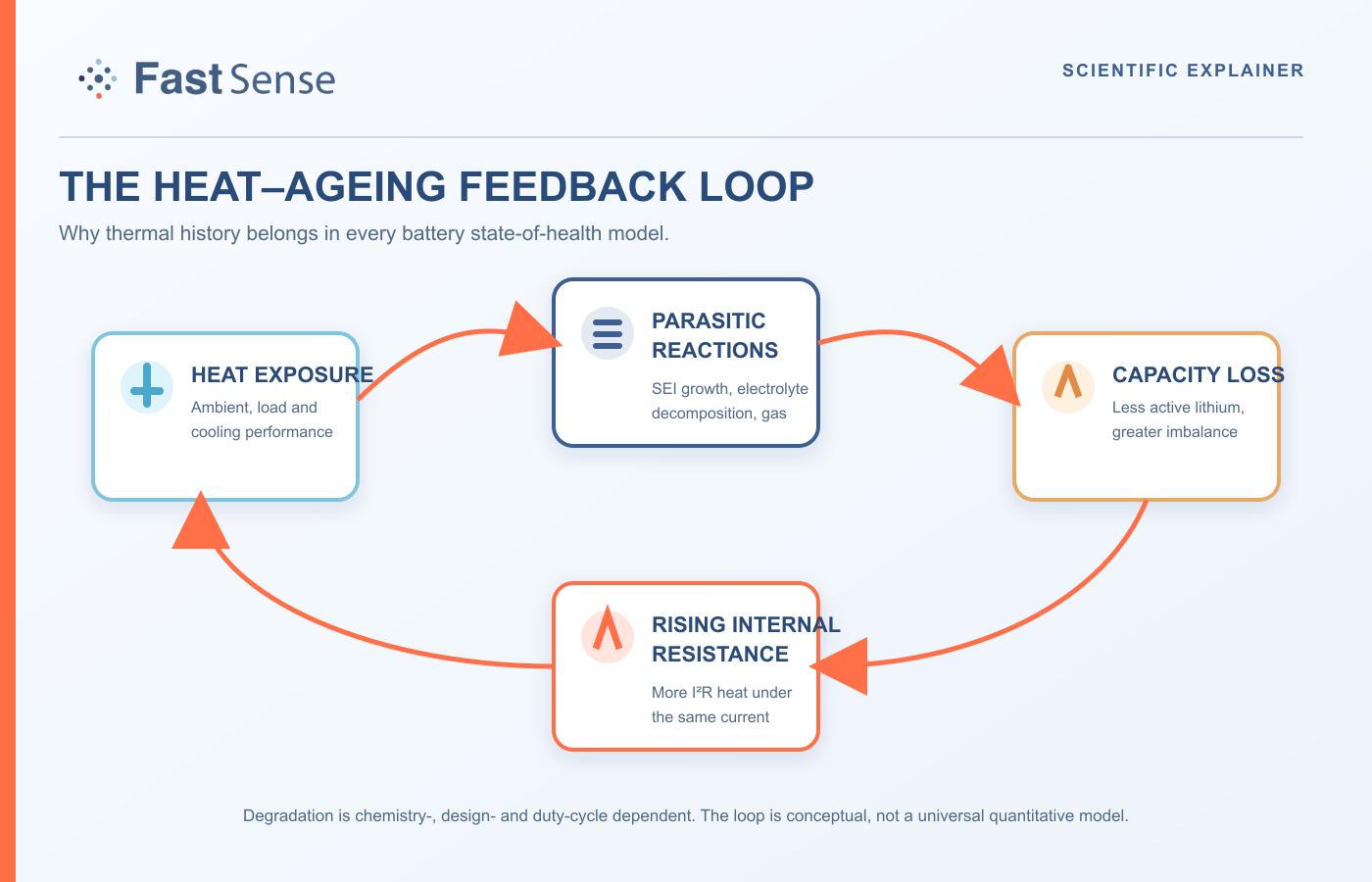
The operational result is a feedback loop. Poor thermal control accelerates ageing. Ageing increases resistance. Higher resistance creates more heat for a given current. That heat can then accelerate ageing further.
This is why thermal history belongs in any serious assessment of battery health. Cycle count alone does not tell the full story.
How ageing can change thermal-runaway risk
There is no single thermal-runaway temperature that applies to every battery. Cell chemistry, design, state of charge, manufacturing quality and abuse history all matter.
Research also shows that the relationship between ageing and safety is not one-dimensional. Some ageing reactions may consume reactive material, while other degradation modes—such as lithium plating, separator damage, internal defects or rising resistance—can increase local heat generation or reduce the margin to failure.
NASA modelling work has noted that, depending on chemistry and abuse history, an ageing cell can show increased resistance and a lower thermal-runaway onset temperature. Sandia and Los Alamos research has also shown that higher state of charge can reduce the onset temperature and increase peak heating rate for some cell chemistries.
The practical point is not that every old battery is unsafe. It is that SOH and thermal safety cannot be managed as separate topics.
Once thermal runaway begins, SOH is no longer the question
During a full thermal-runaway event, the affected cell is catastrophically damaged. Its usable state of health effectively falls to zero.
The bigger concern is propagation. Heat, hot particles and flammable vent gases from the first cell can expose adjacent cells to conditions they were never designed to tolerate. A single-cell event can therefore become a module, rack or container-level emergency.
This is why relying only on smoke or a high-temperature alarm leaves so little room for intervention. Those signals are valuable for emergency response, but they may appear after the battery has entered an irreversible failure phase.
The early-warning gap
A battery management system is essential, but it can only act on the signals it receives. Voltage, current and surface temperature can remain within apparently normal limits while unwanted reactions develop inside a cell.
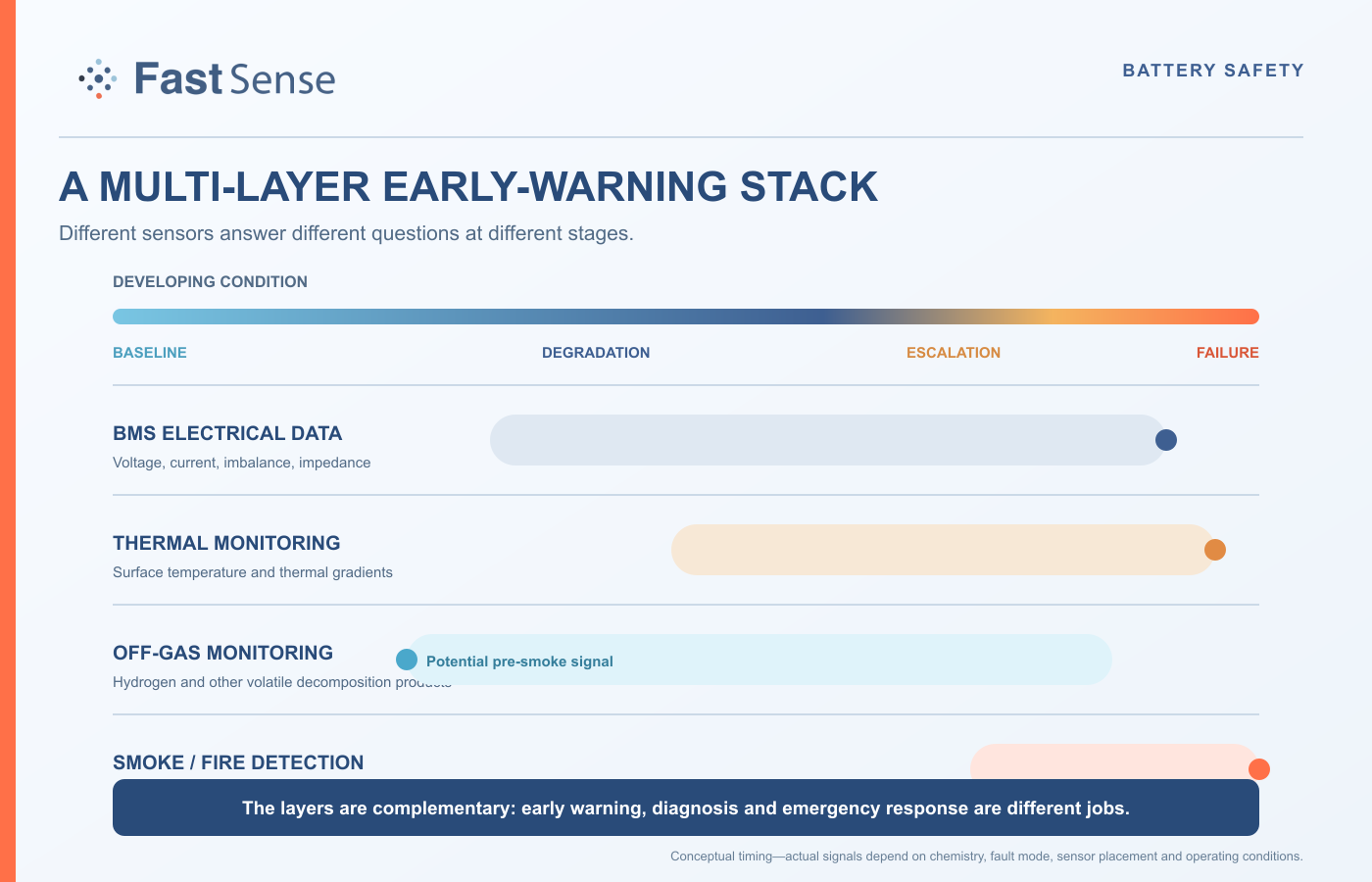
As electrolyte and interphase materials begin to break down, a failing lithium-ion cell can release gases including hydrogen, carbon monoxide, carbon dioxide and light hydrocarbons. Detecting this change in the local atmosphere can add a complementary, pre-smoke layer to conventional electrical, thermal and fire monitoring.
Fast Sense’s own LFP test demonstrated the value of this approach: the hydrogen signal rose well before the rapid temperature increase and voltage collapse associated with the failure event.
The objective is not to replace the BMS, temperature probes or fire detection. It is to give operators another signal—and potentially a larger decision window—to isolate a string, reduce load, investigate a rack or remove a failing asset from service.
What BESS operators should monitor
A more complete battery-health and safety strategy combines multiple layers:
- cell voltage and cell-to-cell imbalance;
- current and charge/discharge history;
- surface and ambient temperature;
- thermal gradients across modules and racks;
- internal resistance or impedance trends;
- cooling-system performance;
- gas and off-gas detection;
- alarms correlated over time rather than treated in isolation; and
- inspection following mechanical, electrical or thermal abuse.
The most useful warning is rarely a single threshold. It is a change from the battery’s own baseline, interpreted in context.
From state of health to state of risk
SOH helps quantify how much performance remains. It does not, by itself, describe every safety mechanism developing inside a battery.
For BESS operators, the stronger approach is to combine state-of-health estimation with thermal history, environmental monitoring and early off-gas detection. That turns battery monitoring from a performance exercise into a risk-management system.
Thermal runaway may happen quickly. The conditions that lead to it may not.
If you build, specify or operate battery storage and want to explore pre-smoke hydrogen detection, talk to the Fast Sense team about adding molecular intelligence to your existing safety stack.
Sources
Latest Posts
Navigating BESS Insurance: How to Handle Risk Assessments When Thermal Runaway Cover Shrinks
September 24, 2026
Battery Fire Safety Getting Crititcal
August 23, 2026