Navigating BESS Insurance: How to Handle Risk Assessments When Thermal Runaway Cover Shrinks
Meta description: Learn why insurers require BESS thermal runaway assessments and how battery off-gassing and H₂ sensors improve early warning, safety and insurability.
Insurance companies increasingly require thermal runaway assessments for Battery Energy Storage Systems (BESS) because lithium-ion battery failures create risks that conventional fire assessments do not fully address.
A thermal runaway event can propagate rapidly between cells and modules, releasing heat, toxic compounds and large volumes of flammable battery off-gases. If these gases accumulate inside a battery container or enclosed energy storage room, they can also create a serious explosion hazard.
For insurers, a thermal runaway assessment provides essential evidence about how a BESS is designed to detect, contain and respond to these hazards. It helps underwriters evaluate probable losses, emergency response requirements, business interruption exposure and the overall insurability of the project.
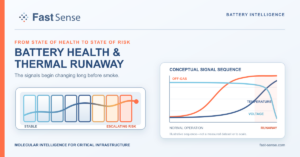
Increasingly, this assessment must consider not only what happens after smoke or fire appears, but also how the system detects the earliest stages of battery failure. This is where continuous battery off-gassing detection and hydrogen sensors for BESS can add a valuable early-warning layer.
What Is Thermal Runaway in a Battery Energy Storage System?
Thermal runaway is a self-accelerating failure process in which heat generated inside a lithium-ion battery cell causes further chemical decomposition and additional heat release.
It may be initiated by:
- Internal short circuits
- Overcharging or over-discharging
- Manufacturing defects
- Mechanical damage
- External heating
- Cooling-system failure
- Electrical or battery-management-system faults
As the cell deteriorates, it can vent a mixture of gases and vapours. Depending on the cell chemistry, state of charge and failure mechanism, these emissions may include hydrogen, carbon monoxide, carbon dioxide, methane, other hydrocarbons and volatile organic compounds.
If the heat from the failing cell reaches neighbouring cells, the event can propagate through a battery module, rack or container. The result may include fire, explosion, toxic emissions, equipment loss and prolonged site shutdown.
Thermal runaway can also continue without an external oxygen supply because oxygen may be released by reactions inside the cell. Even after visible flames have been controlled, damaged cells can remain hot and may reignite.
Why Battery Off-Gassing Matters Before Smoke or Fire
Battery failure does not always begin with visible smoke, flame or a dramatic rise in room temperature. In many failure scenarios, chemical changes and cell venting produce detectable gases before conventional fire detectors activate.
This early gas release is commonly referred to as battery off-gassing.
Off-gassing can provide an important warning that a cell or module is moving away from normal operating conditions. Detecting that change may give operators additional time to:
- Investigate the affected area
- Isolate equipment
- Initiate a controlled shutdown
- Activate ventilation
- Notify emergency responders
- Prevent personnel from entering a hazardous enclosure
The composition and timing of battery off-gas vary considerably. Hydrogen should therefore not be treated as the only indicator of battery failure. However, because H₂ is highly mobile, flammable and associated with a range of lithium-ion failure conditions, it can be a valuable target gas within a multi-layer BESS safety strategy.
How Can an H₂ Sensor Improve BESS Early Warning?
A hydrogen sensor for BESS continuously monitors the atmosphere around battery cabinets, racks, containers or battery rooms for changes in H₂ concentration.
Placed close to potential release points, distributed H₂ sensors can help identify localised off-gassing that might be missed or diluted before reaching a single room-level detector.
When integrated with the site’s control and safety systems, hydrogen detection data can support:
- Early warning alarms
- Battery shutdown procedures
- Ventilation control
- Emergency response escalation
- Identification of the affected rack or enclosure
- Trend analysis and preventive maintenance
- Post-event investigation
An H₂ sensor does not prevent thermal runaway by itself, nor can any single sensor detect every possible battery failure. Its value comes from adding molecular-level information to the wider safety architecture.
A robust BESS monitoring strategy can combine hydrogen and off-gas detection with:
- Battery Management System data
- Cell voltage and temperature monitoring
- Smoke and heat detection
- VOC or multi-gas sensing
- Ventilation monitoring
- Fire detection and suppression
- Site alarms and emergency controls
This layered approach gives operators and insurers a more complete view of both developing faults and active fire or explosion hazards.
How Do Thermal Runaway Assessments Help Insurers Evaluate BESS Risk?
Thermal runaway assessments provide project-specific information about the behaviour of the selected battery technology and system design.
Insurers may use this information to evaluate:
- Cell-to-cell and module-to-module propagation
- Heat-release characteristics
- Quantity and composition of battery off-gas
- Potential for flammable gas accumulation
- Fire and explosion scenarios
- Toxic exposure risks
- Separation distances
- Ventilation and deflagration protection
- Emergency access and firefighting strategy
- Maximum foreseeable or probable loss
- Expected business interruption
The assessment allows an insurer to distinguish between a system that can detect and contain a localised failure and one in which a single cell event could develop into the loss of an entire BESS container or site.
These findings can influence coverage limits, exclusions, deductibles and required risk improvements. Strong test evidence and a well-documented protection strategy may also make a project easier to place in the insurance market.
Which BESS Safety Standards and Tests Do Insurers Consider?
Requirements vary by project, jurisdiction, insurer and Authority Having Jurisdiction. However, BESS insurance reviews commonly consider several recognised standards and test frameworks.
UL 9540A
UL 9540A is a test method used to evaluate thermal runaway fire propagation in battery energy storage systems. Testing can provide data on cell failure, gas generation, heat release, flaming behaviour and propagation at cell, module, unit and installation levels.
Insurers and fire authorities may use UL 9540A results to evaluate whether the proposed BESS design and mitigation measures are appropriate for the installation.
NFPA 855
NFPA 855 addresses the installation of stationary energy storage systems. It covers areas such as system location, separation, fire protection, ventilation, explosion control and emergency planning.
IEC 62933
The IEC 62933 family covers electrical energy storage systems, including safety considerations for grid-connected installations.
Compliance alone does not eliminate risk. Insurers will normally also examine how the specific system is configured, installed, monitored, maintained and operated at the proposed site.
Why Aren’t Conventional Fire-Safety Measures Enough?
Conventional smoke, heat and flame detection remains essential, but these technologies generally respond after a failure has already produced significant physical effects.
Battery off-gassing detection looks for an earlier chemical signal.
Likewise, fire suppression may control flames and protect nearby equipment, but it may not immediately stop the reactions occurring inside a failing cell. Cooling is often critical for limiting propagation and preventing further cells from entering thermal runaway.
The complete safety challenge can include:
- Detecting early cell venting
- Preventing flammable gas accumulation
- Controlling ignition and explosion risks
- Cooling adjacent cells and modules
- Managing toxic emissions
- Monitoring for re-ignition
- Protecting emergency responders
- Safely recovering and recommissioning the site
This is why insurers assess BESS fire safety as a combination of prevention, detection, ventilation, containment, suppression and emergency response—not simply the presence of a conventional sprinkler or smoke alarm.
Can H₂ Detection Strengthen a BESS Insurance Submission?
Continuous hydrogen monitoring can demonstrate that the project has considered the period between normal battery operation and an active fire alarm.
For insurers, useful evidence can include:
- The gases targeted by the detection system
- Sensor detection range and response time
- Sensor placement and coverage
- Alarm thresholds and escalation logic
- Integration with shutdown and ventilation systems
- Calibration and maintenance procedures
- Fault diagnostics and system availability
- Operator response procedures
- Testing or validation under representative conditions
H₂ sensor data can also support ongoing risk management after the BESS becomes operational. Changes in gas readings may reveal abnormal battery behaviour, ventilation issues or developing equipment faults that require investigation.
The objective is not simply to generate another alarm. It is to turn an early molecular signal into a defined and timely operational response.
How Do Thermal Runaway Assessments Affect Financing and Project Development?
Insurance is often a condition of BESS financing. Lenders and investors want confidence that major fire and explosion risks have been identified and that suitable controls are included in the project design.
If thermal runaway testing, gas detection, ventilation or emergency planning is addressed too late, insurers may require design changes after procurement or construction has begun. This can result in:
- Additional engineering costs
- Delayed commissioning
- Retrofitted detection or ventilation
- Higher insurance costs
- Restricted coverage
- Financing delays
The best approach is to begin the thermal runaway and insurance review during the design phase. This allows testing evidence, sensor placement, ventilation design and emergency controls to be considered together before the system is installed.
Earlier Molecular Insight for Safer BESS Operations
Thermal runaway assessments help insurers understand how a BESS will behave during a battery failure. Continuous off-gassing monitoring helps operators identify when that failure may be beginning.
Fast Sense develops compact, low-power hydrogen sensing technology for battery cabinets, energy storage containers and BESS facilities. Distributed H₂ sensing adds real-time molecular intelligence to existing battery management, fire detection and site-control systems.
By detecting hydrogen associated with battery off-gassing, operators can gain earlier awareness, respond faster and make better-informed safety decisions before an abnormal condition develops into a major event.
Catch what others missed.
Talk to Fast Sense about integrating distributed hydrogen and battery off-gas detection into your BESS safety and risk-management strategy.
Latest Posts

Battery Fire Safety Getting Crititcal
August 23, 2026